讲稿(每页的时间为累计)Talk script (times are cumulative)
【1,0:00–1:00】各位好。今天讲一个很实际的问题:XMM 的好时间间隔筛选能不能只用光变曲线来做,以及它的规则第一次被冻结判决的结果。45 分钟,最后留 10 到 15 分钟提问。[1, 0:00-1:00] Hello. Today: can XMM good-time-interval screening be done from light curves alone, and what the first frozen verdict on such rules says. 45 minutes, then 10-15 minutes of questions.
【2,1:00–3:00】先说痛点。同一片天空的两次观测,背景水平可以差 20%,而弥散工作的科学预算只有 5%。软质子随时涨落,GTI 是每条光谱背后的第一道筛选,但它的规则从来没被判决过。今天你们会带走三件事:政策族能走多远、冻结判决怎么说、你的数据该不该换规则。[2, 1:00-3:00] First the pain. Two observations of the same sky can differ by 20% in background level, while diffuse work has a 5% science budget. Soft protons flare at any time; the GTI is the first screen behind every spectrum, but its rules have never been put on trial. You will take away three things: how far the policy family gets, what the frozen verdict says, whether your data should switch rules.
【3,3:00–4:00】路线图:背景、数据与方法、三个结果、意义与下一步。[3, 3:00-4:00] Roadmap: background, data and method, three results, meaning and next steps.
【4,4:00–6:00】EPIC 每 1000 秒读出一帧,我们的打分也切成 1000 秒的段。角落常被当粒子监控器用,但角落也吃天光。软质子是磁层聚焦的低能带电粒子,时间上无规则,谱形与弥散热发射重叠 —— 这就是它难缠的原因。[4, 4:00-6:00] EPIC reads out a frame every 1000 s, and our scoring cuts light curves into 1000 s pieces. Corners are often used as particle monitors, but corners see sky too. Soft protons are low-energy charged particles focused by the magnetosphere, irregular in time, spectrally overlapping diffuse thermal emission — that is why they are hard.
【5,6:00–8:00】为什么弥散发射最受伤?点源可以减背景,弥散发射不能 —— 它就是背景。5% 的系统误差在点源工作里可以忽略,在弥散工作里是判决级的。所以我们选观测间一致性做判据。[5, 6:00-8:00] Why does diffuse emission suffer most? Point sources can subtract a background; diffuse emission cannot — it is the background. A 5% systematic a point-source analysis ignores is verdict-level for diffuse work. So our criterion is between-observation consistency.
【6,8:00–10:00】判据是 \(\sigma_R\):同一片天空同一批政策下,观测与观测之间 0.5–2 keV 拼接光变曲线水平的散布,逐观测配对自举给 p16/p84。注意它不含观测间水平项,也不直接奖励多删 —— 但多删能降散布,所以保留时间必须与判决同报。[6, 8:00-10:00] The criterion is \(\sigma_R\): the scatter of the 0.5-2 keV concatenated light-curve level from observation to observation on the same sky under the same policy, with p16/p84 from a per-observation paired bootstrap. It carries no between-observation level term and does not directly reward cutting more — but cutting more lowers the scatter, so kept time must be reported with the verdict.
【7,10:00–12:00】政策族:83 个候选、23 个家族,只用全视场 0.5–2 keV 光变曲线做阈值、斜率、多尺度形状筛选。角落数据从不进入决策 —— 这是与文献方法的核心区别。[7, 10:00-12:00] The policy family: 83 candidates in 23 families, screening the full-field 0.5-2 keV light curve by thresholds, slopes and multi-scale shapes. Corner data never enter the decision — the core difference from the literature.
【8,12:00–14:00】规则先冻结:2026-10-18T15:33Z,83 个候选、23 个脚本、11 条命令,清单哈希存档。之后只有失败的可执行回归能改代码。一次运行在保留集观测的空天空坐标上停住,修复带回归测试,发展数据逐位不变。[8, 12:00-14:00] Freeze the rule first: 2026-10-18T15:33Z, 83 candidates, 23 scripts, 11 commands, manifest hashed. Afterwards only a failing executable regression may change code. One run stopped on null sky coordinates in a held-out observation; the fix carries a regression test and leaves development data bit-identical.
【9,14:00–16:00】保留集:119 个从未参与设计的观测,六个天空格 —— 两个开发、两个复验、两个新天空。主参照是归档 2.filter,次参照是复现滤波器。[9, 14:00-16:00] The held-out set: 119 observations that took no part in the design, in six sky cells — two development, two confirmation, two new-sky. Primary reference: the archived 2.filter; secondary: a reproduced filter.
【10,16:00–18:00】判决规则:至少 4 个格增益、两个新天空格都增益、无伤害格。增益的阈值是 p84 差 \(<-0.5\) 个百分点。[10, 16:00-18:00] The verdict rule: at least 4 cells gain, both new-sky cells gain, no harm cell. The gain threshold is a p84 difference \(<-0.5\) percentage points.
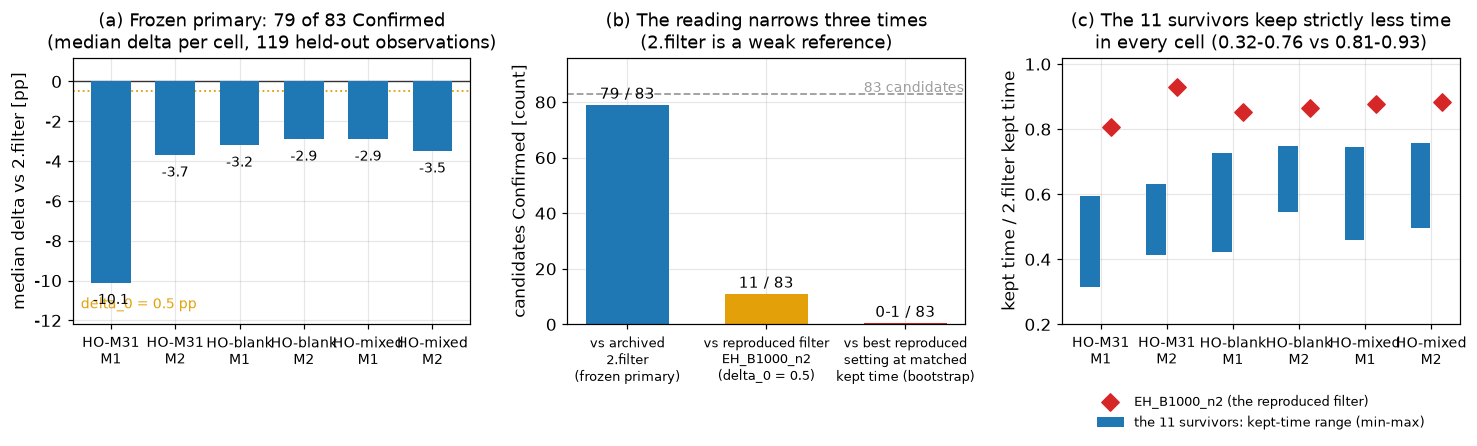
【11,18:00–20:00】读数分三层,这张表是全场的骨架:归档参照 79/83,复现参照 11/83,等保留时间 0–1/83。下面逐层展开。[11, 18:00-20:00] The reading has three layers; this table is the skeleton of the whole talk: 79/83 against the archived reference, 11/83 against the reproduced filter, 0-1/83 at matched kept time. Now each layer.
【12,20:00–21:00】三个结果,每个我都会说三遍:预览、展示、总结。[12, 20:00-21:00] Three results; I will say each three times: preview, show, summary.
【13,21:00–24:00】看这张图。横轴是 83 个候选,纵轴是配对差 \(\delta\)(百分点)。蓝点对归档 2.filter,红点对复现滤波器,误差条是配对自举的 p16/p84。大部分蓝点在零线以下 —— 79/83 Confirmed,中位改善 2.9 到 10.1 个百分点。[13, 21:00-24:00] Look at this figure. The x-axis is the 83 candidates; the y-axis is the paired difference \(\delta\) in percentage points. Blue: vs the archived 2.filter; red: vs the reproduced filter; error bars are the paired-bootstrap p16/p84. Most blue points sit below zero — 79/83 Confirmed, median improvement 2.9 to 10.1 percentage points.
【14,24:00–26:00】但增益大多是拼接层面的:73/79 集中在少数格。HO-M31 MOS1 的 \(-10.1\) pp 里约 4.6 pp 是一个坏参照文件。这提示我们:判决是真的,但增益的构成要拆开看。[14, 24:00-26:00] But the gain is mostly mosaic-level: 73/79 concentrated in a few cells. About 4.6 pp of the HO-M31 MOS1 \(-10.1\) pp is one broken reference file. The verdict is real, but the composition of the gain must be taken apart.
【15,26:00–29:00】第 2 层:一个 espfilt 加硬段裁剪的复现滤波器 —— 标准做法的忠实复现 —— 已经拿到最优候选增益的一半以上。相对它只剩 11/83,而且全部保留更少时间:0.32–0.76 对 0.81–0.93。[15, 26:00-29:00] Layer 2: a reproduced filter — espfilt plus a hard-band clip, a faithful reproduction of standard practice — already delivers more than half of the best candidate's gain. Against it only 11/83 survive, all keeping less time: 0.32-0.76 vs 0.81-0.93.
【16,29:00–33:00】第 3 层最关键:把保留时间配平再比。每个候选与"保留至少同样多时间的最好复现滤波器设置"比较,48 个设置的阶梯,逐观测配对自举。点估计下 37/83 领先,配对自举下只剩 0–1 个。结论:优势未确立。这是预先注册的下一个测试要回答的问题。[16, 29:00-33:00] Layer 3 is the crux: match the kept time, then compare. Each candidate faces the best reproduced-filter setting that keeps at least as much time — a ladder of 48 settings — under a per-observation paired bootstrap. Under the point estimate 37/83 lead; under the bootstrap only 0-1 remain. Conclusion: the advantage is not established. The pre-registered next test answers exactly this.
【17,33:00–36:00】四条局限:参照强度(204 个非候选里 50 个也过同一条规则);保留时间不在判决里;增益构成(73/79 集中);未检验的部分(Al-K 线门只在 0–3 个观测上触发,谱验证未做)。[17, 33:00-36:00] Four limitations: reference strength (50 of 204 non-candidates also pass the same rule); kept time outside the verdict; gain composition (73/79 concentrated); the untested parts (the Al-K line gate fires on 0-3 observations per cell; spectral validation not done).
【18,36:00–45:00】总结。79/83 相对归档参照 —— 光变曲线筛选值得继续。11/83 相对复现滤波器 —— 大半增益来自删更多。0–1/83 等保留时间 —— 优势未确立,P007 预注册回答它。判据、规则、代码全部冻结可查。谢谢。[18, 36:00-45:00] Summary. 79/83 against the archived reference — light-curve screening is worth continuing. 11/83 against the reproduced filter — most of the gain is cutting more. 0-1/83 at matched kept time — the advantage is not established; the pre-registered P007 answers it. The criterion, the rule and the code are all frozen and checkable. Thank you.
预期问答Anticipated Q&A
问:为什么不直接用 ESAS?答:ESAS 是建模背景,不是筛选时间;两者互补,我们比较的是筛选规则本身(备用 1)。Q: Why not just use ESAS? A: ESAS models the background rather than screening time; the two are complementary, and we compare the screening rules themselves (Backup 1).
问:等保留时间下功效够吗?答:接近零,所以那里是描述性读数;P007 提高功效(备用 3)。Q: Is the matched-kept-time comparison well powered? A: Near zero, so there it is descriptive; P007 raises the power (Backup 3).
问:角落为什么不用?答:角落也吃天光,且我们要求政策可迁移到任何观测(备用 1)。Q: Why not use the corners? A: Corners see sky too, and we require policies transferable to any observation (Backup 1).
问:软质子事件会不会与真实变源混淆?答:会,所以判据是观测间一致性,不是单观测内的形状(备用 1)。Q: Could soft-proton flares be confused with real variability? A: Yes, which is why the criterion is between-observation consistency, not within-observation shape (Backup 1).
问:\(\sigma_R\) 为什么不含水平项?答:冻结时的选择;水平项在拼接图上另测(备用 2)。Q: Why does \(\sigma_R\) carry no level term? A: A freeze-time choice; the level term is measured separately on mosaics (Backup 2).
问:坏参照文件那 4.6 pp 会不会推翻判决?答:不会,它是 79 个中的一个格,且已从增益中拆出(备用 2)。Q: Does the 4.6 pp from the broken reference file overturn the verdict? A: No; it is one cell of the 79 and has been separated from the gain (Backup 2).
问:结果对别的望远镜通用吗?答:方法通用(光变曲线 + 冻结判决),数值不通用(备用 3)。Q: Do the results generalise to other telescopes? A: The method does (light curves + a frozen verdict); the numbers do not (Backup 3).
问:为什么不用深度学习?答:83 个可解释规则已经足够暴露判据的结构,且可冻结(备用 3)。Q: Why not deep learning? A: 83 interpretable rules already expose the structure of the criterion, and they can be frozen (Backup 3).
总时长 45:00(目标 45 分钟,偏差 0%)。Total 45:00 (target 45 min, deviation 0%).